A vision born in faith.
A legacy carved in stone.
More than seven decades of unwavering service to the Deaf and Hard-of-Hearing community — from a bold idea pooled together by Lutheran pastors to a 86-acre estate that has become one of Long Island's most enduring nonprofit homes.
A vision shared by Lutheran pastors.
More than seventy-five years ago, a small group of Lutheran pastors shared a bold and tender vision: to establish a high-quality education in a loving, faith-centered environment for Deaf children on the East Coast of America — a community they believed had been underserved and overlooked by the world around them.
That vision became real in 1947, when they formally founded Lutheran Friends of the Deaf (LFD) — the organization that, more than seventy-five years later, continues as the governing entity behind everything we do today. From their founding meeting forward, the question was no longer whether to build a school. The question was where.
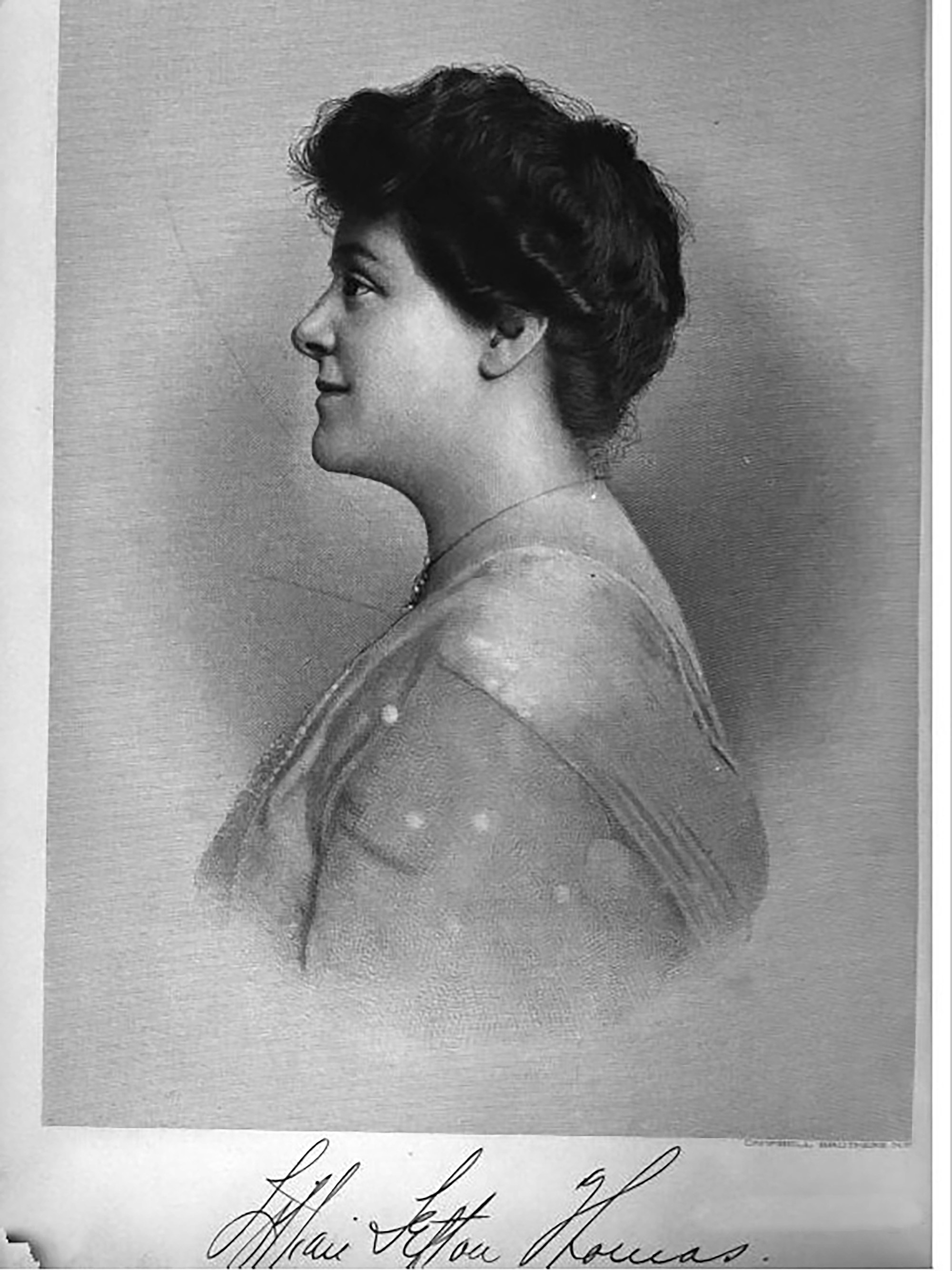
The estate that became Mill Neck began as the dream of Lillian Sefton Dodge.
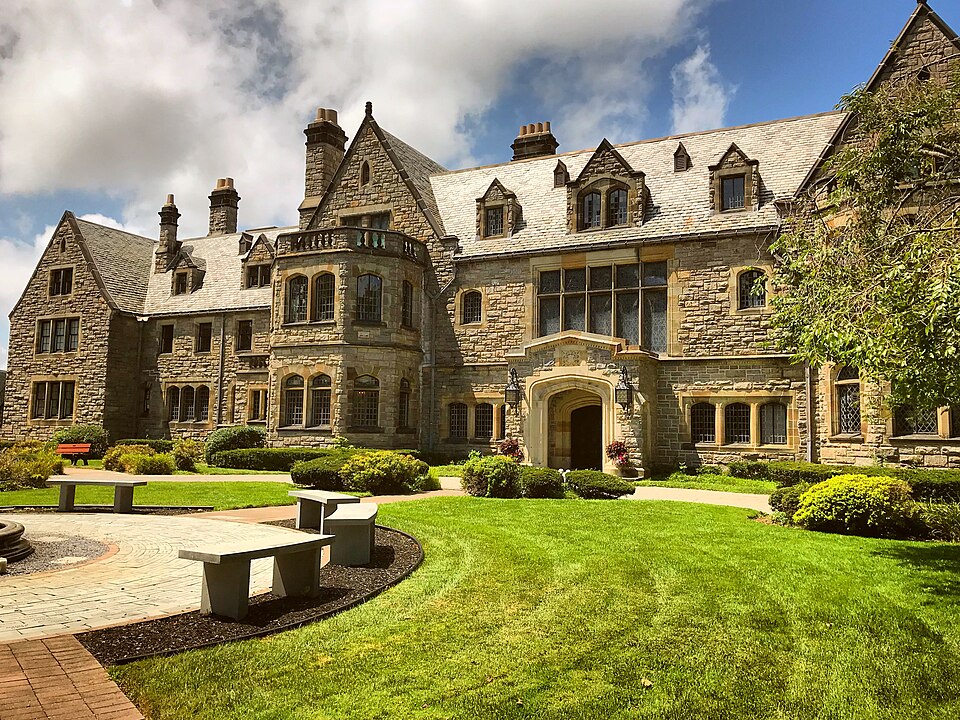
In the 1930s, Lillian Sefton Dodge was the highest-paid female executive in the United States — president of the Harriet Hubbard Ayer cosmetics company and a woman whose ambition was matched only by her taste. In 1922, she commissioned the renowned New York architectural firm Clinton & Russell, Wells, Holton & George to design her a 60,000-square-foot, 34-room Tudor Revival mansion on 86 acres of Long Island's prestigious Gold Coast.
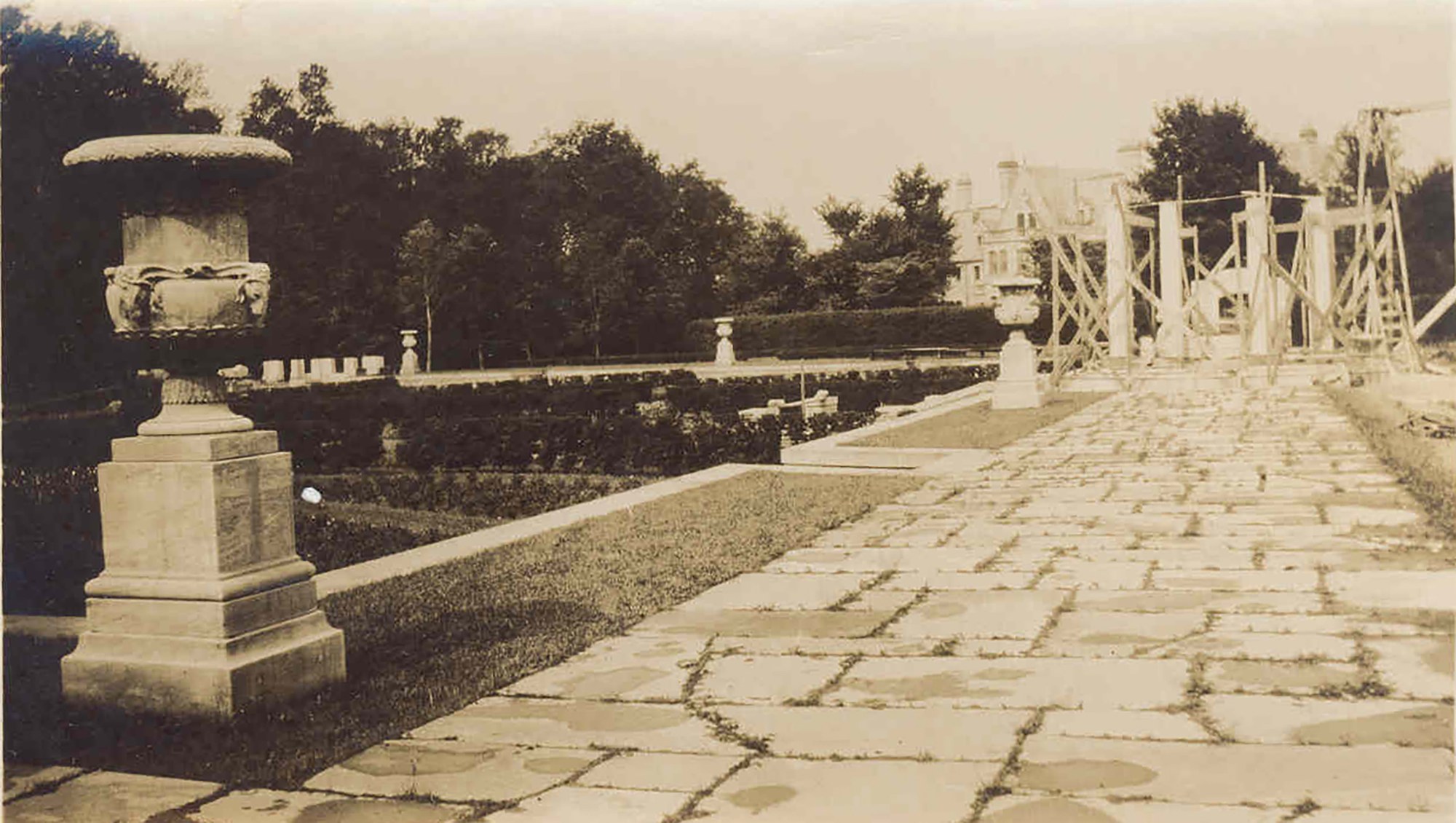
Inspired by St. Catherine's Court in Somersetshire, England, the home was completed in 1925 and named Sefton Manor. It featured rusticated Westchester granite walls, a 500-year-old solid oak doorway, ornate Connick stained glass, formal gardens by landscape artist Charles Leavitt, and a great hall fit for royalty.
In 1949, with her husband Robert Leftwich Dodge having passed, Mrs. Dodge entered into negotiations with the Lutheran Friends of the Deaf. She agreed to sell the estate she had built — her life's home — for a fraction of its value. On November 1, 1949, the deed was transferred.
$216,000 and a leap of faith.
The Lutheran pastors did what only people of deep conviction would do: they pooled their own personal finances and resources to make their dream a reality. Through the support of the Lutheran Women's Missionary League of the Atlantic and English Districts and the wider Synod, they raised $74,728.05 to seed the project.
They purchased the entire Sefton-Dodge Estate — all 86 acres, the 34-room mansion, the stained glass, the gardens, the carriage house, and every outbuilding — for just $216,000.
It was an act of communal sacrifice. They became only the second owners in the estate's history. And they immediately set to work transforming a Gold Coast mansion into a school.
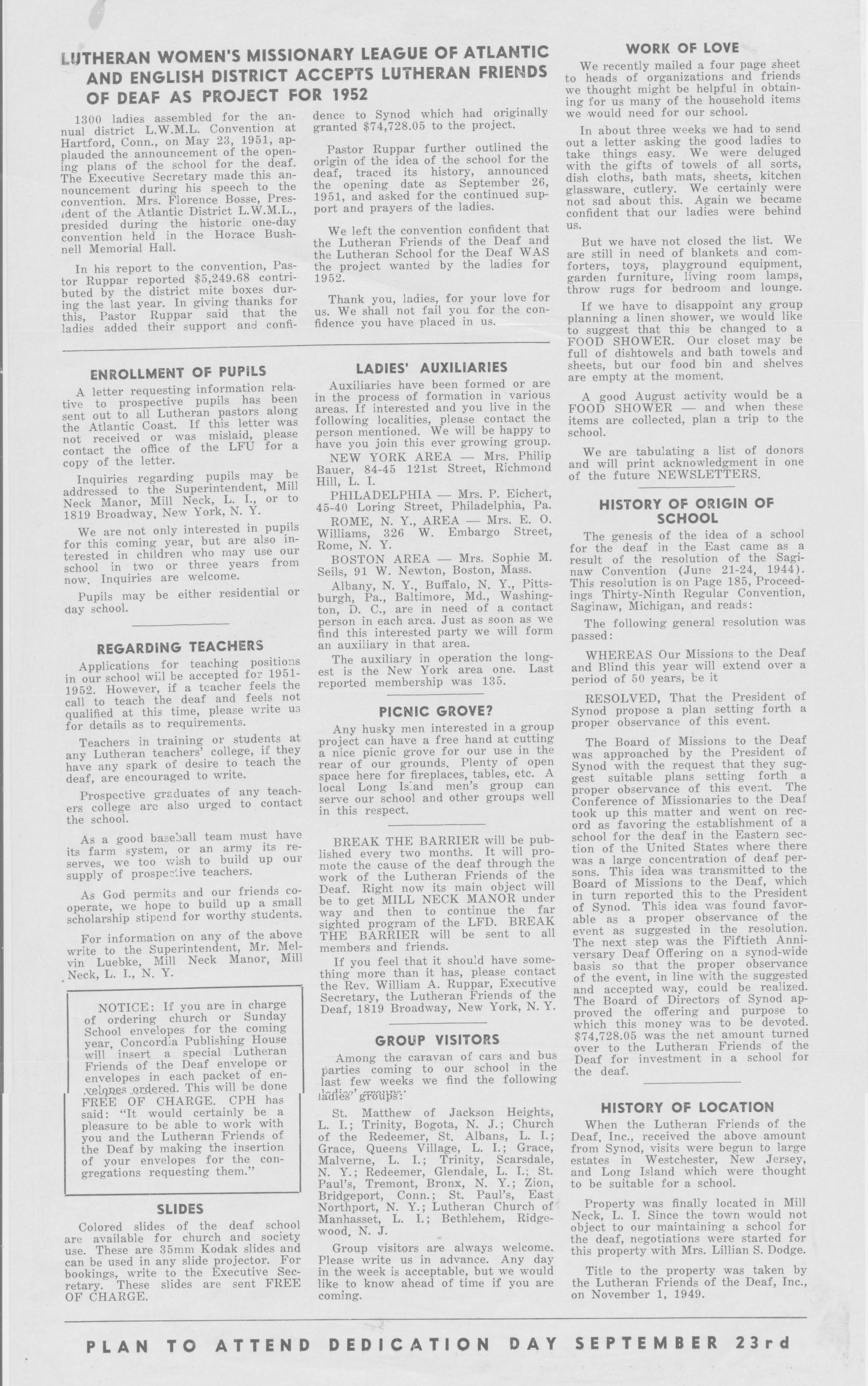
"Plan to attend dedication day, September 23rd."
From the original 1951 newsletter of the Lutheran Friends of the Deaf, distributed to congregations across the Atlantic District. It traces the origin of the school to a resolution passed at the Saginaw Convention of June 1944, where the Synod first formally proposed a fiftieth-anniversary observance of deaf and blind missions — and from which sprang the vision of a school for the Deaf on the East Coast.
It tells how the Board of Missions, led by Pastor Ruppar, identified Mill Neck and began negotiations with Mrs. Lillian S. Dodge, taking title to the property on November 1, 1949. It announces the opening of pupil enrollment, the call for prospective teachers, and a campaign called Break the Barrier.
"As God permits and our friends co-operate," it reads, "we hope to build up a small scholarship stipend for worthy students."
How a school was born.
A timeline of faith, growth, and unwavering mission.
From 1949 to today — every milestone, every dedication, every step forward in our seventy-five-year journey.
Sefton Manor Becomes Mill Neck
The Lutheran Friends of the Deaf purchased Sefton Manor and all 86 of its acres from Lillian Sefton Dodge for $216,000, with the intent of opening a school for the Deaf inside the home. Title was transferred November 1, 1949.
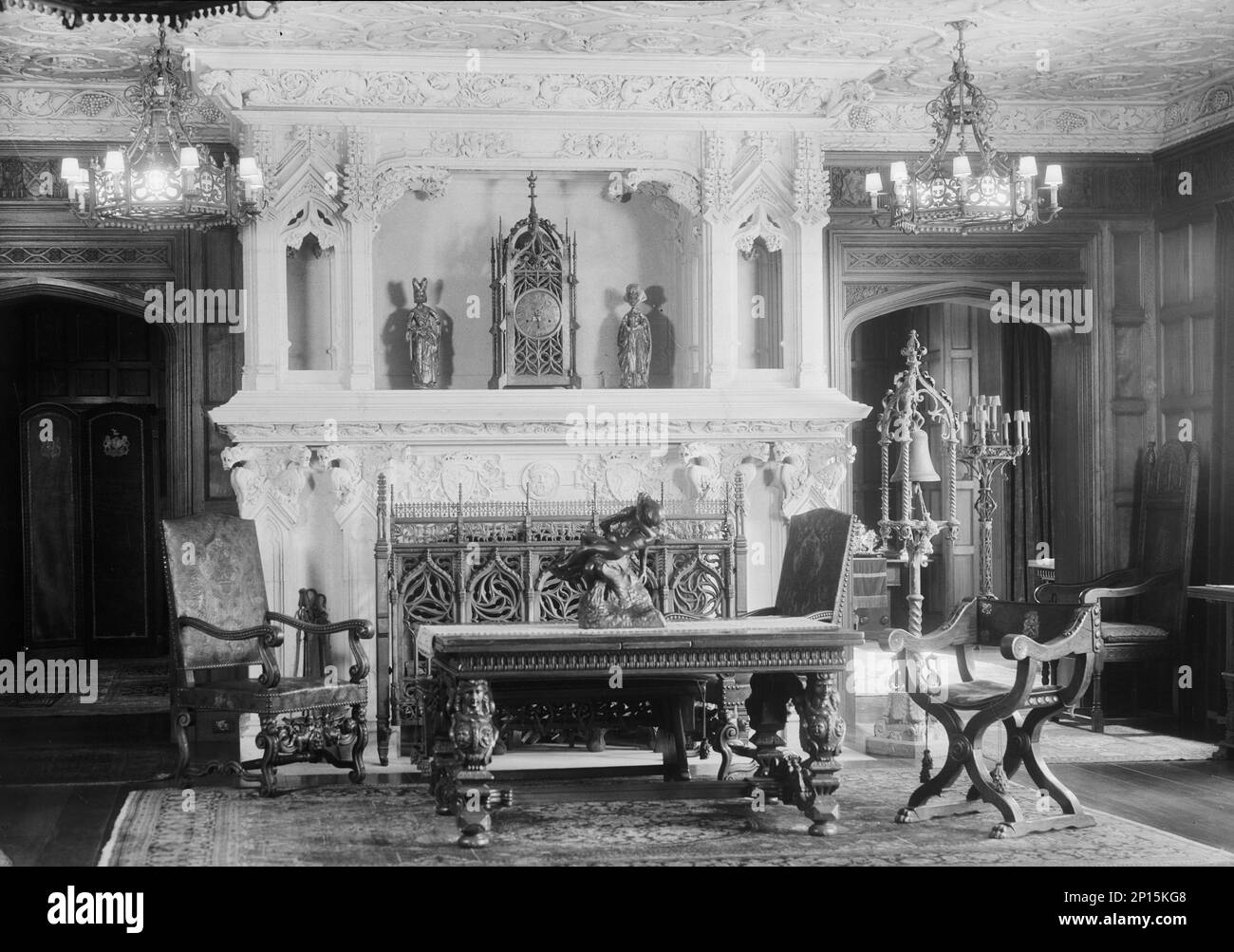
Dedication Day · September 23
Approximately 3,500 people attended the Sunday dedication of the Manor House. The name was officially changed from Sefton Manor to Mill Neck Manor.
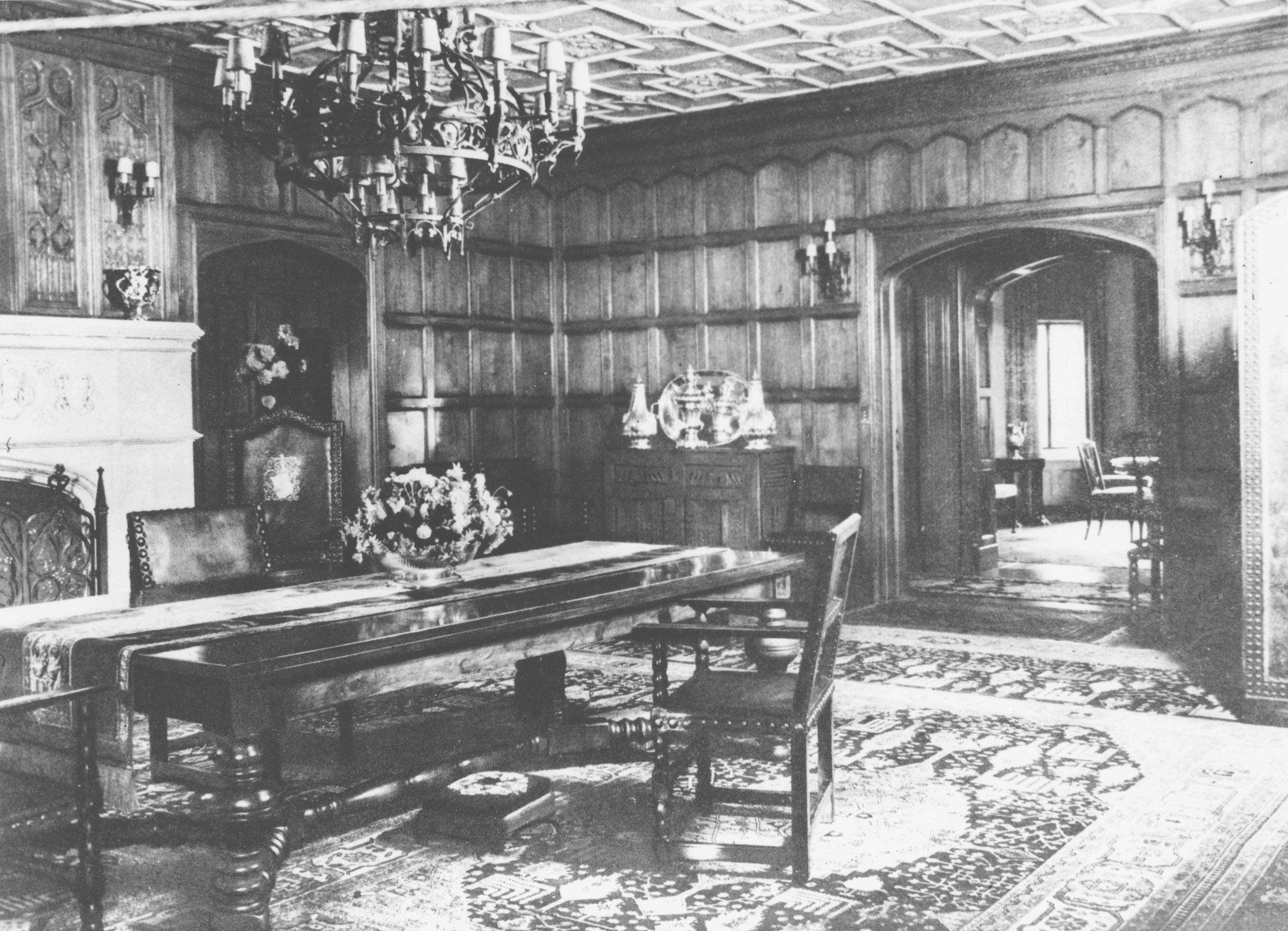
The School Opens · September 26
Just three days after dedication, the Mill Neck Manor School for the Deaf officially opened its doors, serving 19 Deaf boys and girls. Within three years, enrollment had grown to 40 students.
Absolute Charter from NYS
The Board of Trustees received the Absolute Charter from the New York State Board of Regents for operation as a school for the Deaf — granting permanent recognition under the state's 4201 institution framework.
The Farm Buildings Become Classrooms
The farm buildings on the estate — originally built in 1929 — were converted into new classrooms for the expanding school. Other outbuildings on the grounds became offices, supporting the school's growing administrative footprint.
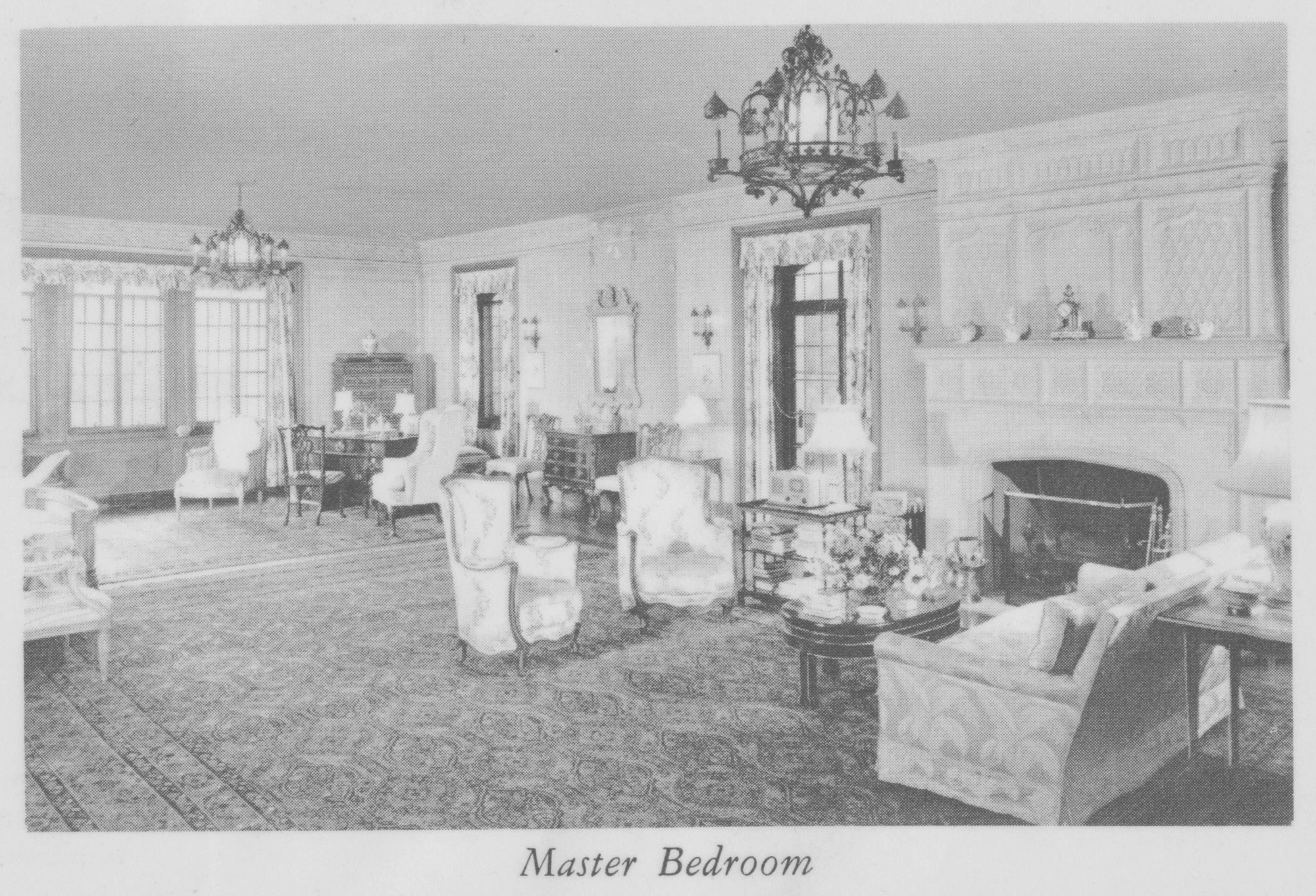
The John of Beverley Chapel
On September 14, the John of Beverley Chapel was officially dedicated within Mill Neck Manor — named for the 7th-century saint who, according to tradition, was the first to teach a Deaf man to speak. It remains a place for the school's students to gather in prayer.
The Library Opens
The newly constructed library opened on the third floor of Mill Neck Manor, offering a wealth of resources to students. The first library card was presented to then-Governor Nelson A. Rockefeller — a sign of how prominent the school's mission had become in New York public life.
Physical Education Building Dedicated
The Mill Neck Manor School's new physical education building was officially dedicated — answering a long-standing need for athletic and recreational space on campus.
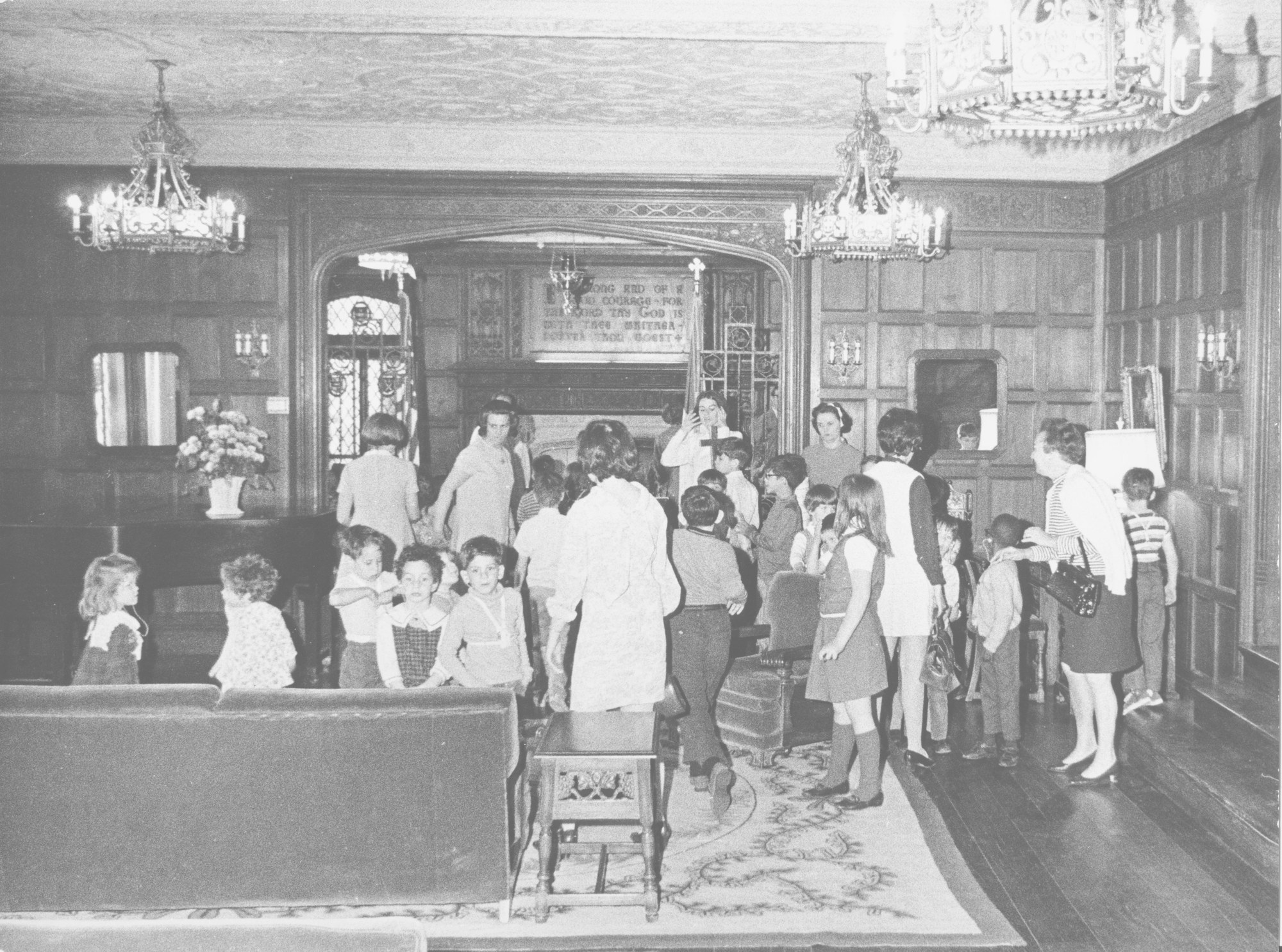
The Wood Memorial Building
The Samuel J. and Evelyn L. Wood Memorial Building was officially dedicated, giving Mill Neck Manor School more room for classes as the student body continued to grow.
The Infant Toddler Program Begins
Recognizing that Deaf infants and their parents needed assistance as early as possible, the Mill Neck Manor Board of Directors approved the launch of the Infant Toddler Program — extending services down to the earliest months of life.
Mill Neck Services Is Born
Mill Neck Services officially began operating as an entity within Mill Neck Center for the Deaf, providing vocational services to Deaf and Hard-of-Hearing adults — a watershed expansion beyond children's education.
The Audiology Clinic Opens
The Mill Neck Audiology Clinic — the beginning of what is now known as the Center for Hearing Health — was established to provide audiological services to Hard-of-Hearing children and adults across Long Island.
Day Habilitation Program Launches
Mill Neck Services officially opened its Day Habilitation Program, providing comprehensive support to Deaf, Hard-of-Hearing, and non-verbal adults with a range of developmental and intellectual disabilities.
The Deaf Education Center
The Deaf Education Center (DEC) was completed on Mill Neck's grounds, opening for classes the following year — offering new, state-of-the-art facilities for the Mill Neck Manor School for the Deaf, including modern classrooms designed for visual learning and ASL instruction.
The First Auditory/Oral Preschool Class
The first Auditory/Oral Preschool Class opened at the Deaf Education Center — expanding our pedagogical approach to include auditory-oral instruction alongside bilingual ASL/English education.
The Manor House Opens to the Public
After serving for years primarily as administrative space, Mill Neck Manor began offering monthly public tours — inviting the broader Long Island community to experience the architectural and historical significance of the estate.
Preservation Begins
Mill Neck Manor entered into an ongoing process of restoration and preservation — for the dual purpose of improving the monthly tours for the public and ensuring the estate's continuing service to Mill Neck Center for the Deaf for generations to come.
The mission continues.
Today, Mill Neck Center for the Deaf serves the Deaf and Hard-of-Hearing community across Long Island and around the world — through education, adult services, philanthropy, and faith. Our school welcomes new students each year. Our adult services empower hundreds of individuals to live full lives. Our foundation extends our reach to Ethiopia and beyond. And our Manor House stands as a living testament to seventy-five years of unwavering commitment.
A landmark beyond our walls.
The Lillian Sefton Dodge Estate was added to the U.S. National Register of Historic Places on July 22, 1979 (NRHP reference No. 79001595) — formal recognition of the architectural significance of the 1922–1925 Clinton & Russell Tudor Revival mansion.
Today, Mill Neck Manor is one of the few Gold Coast estates that has been continuously cared for and put to active use serving a public mission since its original construction. We are stewards not just of an organization, but of an American landmark.
Visit the Manor